The Judge's Seat
- Why did Amnesty's climate trial campaign make participants the judge instead of the audience?
- Why do people act on verdicts they reach themselves rather than conclusions they're told to believe?
- How does the desire to become a better person drive participation in a campaign?
- How should an interactive video campaign be designed so choices aren't just decoration?
- What do participatory campaigns usually fail to do after the moment of participation?
People who hear a conclusion nod. People who reach one, move. In The Strange Trial, we didn't design a message. We designed the moment someone reaches a verdict on their own. What moved them wasn't logic. It was the wish to be a better judge — a better version of themselves.
Climate campaigns speak a familiar language. Melting glaciers. A polar bear adrift on a shrinking floe. A graph climbing too fast. And the line that always closes it out: "Act now." None of it is wrong. The problem is that everyone already knows it.
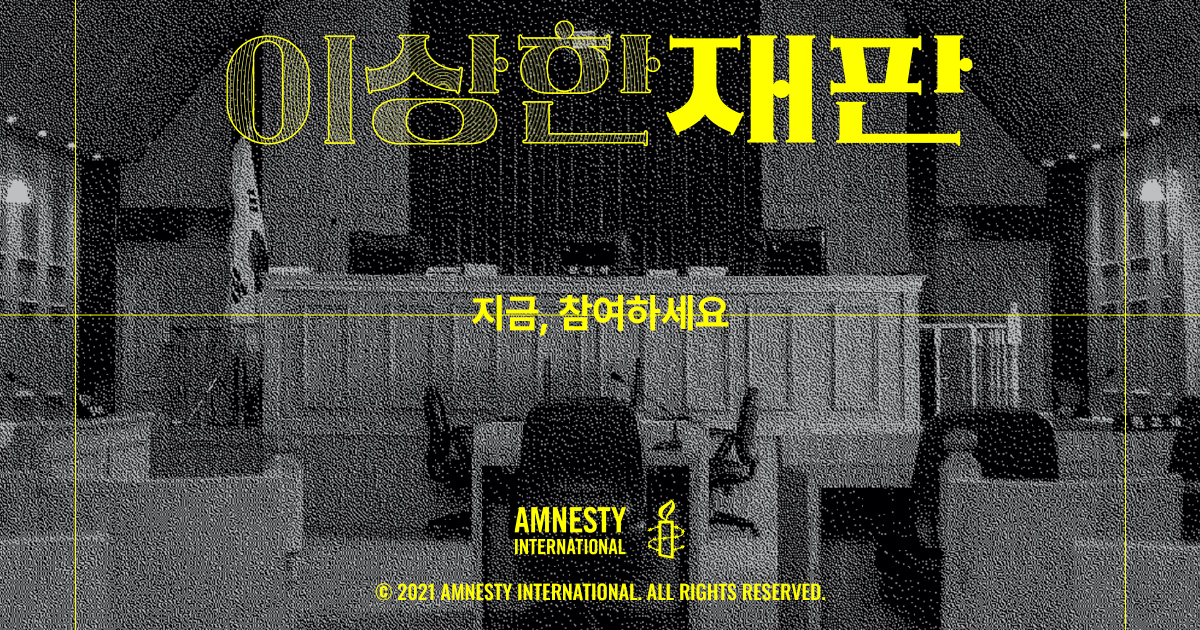
On July 23, 2021, a hundred days before COP26, Amnesty International Korea released The Strange Trial, a campaign about the climate crisis and human rights. The question we sat with longest wasn't what to say. It was how to make people hear, once more and properly, something they'd already been told. Information wasn't scarce. Plenty of people had heard the conclusion that the climate crisis is real. Few had reached it themselves.
Knowing something and believing it are different things. For most people, the climate crisis lived in the folder marked "known" — heard on the news, seen in a campaign, nodded at. That conclusion is accurate. It's also weightless, because it was never theirs. Saying the same conclusion again, louder, doesn't add weight to that folder.
So we removed the audience seats. In their place, we put one bench. The opening line read: "Press start, and you become the judge in this trial."
A trial withholds the verdict
A trial is a form that defers its conclusion. An ad states its conclusion in the first frame. A trial withholds its verdict until the very end — through testimony, evidence, objections. Only after all of it does someone hand down a judgment. What we wanted to borrow was that suspension. A conclusion held in reserve is what keeps someone listening to the end.
There were other participatory formats we could have used — quizzes, petitions, tests. But a quiz already has a correct answer, and a petition already has a conclusion; the participant only matches an answer or adds a name to a sentence already written. A trial was different. A judge isn't someone who matches an answer. A judge is someone who makes one. What we were looking for wasn't participation. It was judgment.
There were three cases. A farmer whose carefully tended apple orchard was ruined by an unseasonal cold snap. A second-grader who, having watched a nearby hillside catch fire twice, is afraid her house will burn down. A delivery worker gasping through a soaked mask in a downpour, still making deliveries. All three were fiction, built from the shape of real climate lawsuits at home and abroad. No polar bears. No glaciers. Neighbors, instead. Moving the climate crisis from a distant landscape to the situation next door — that was the standard behind every case we chose.
And what each plaintiff was asking for was, in its own way, strange. A farmer suing for 1,000 won in damages. A child asking the government to hold back her fear. A worker asking to be allowed to stop delivering in the rain. That's where the campaign's title came from. A strange demand makes you pause. The moment you ask "why 1,000 won?", you've already stepped into the case.
But the demand wasn't the only strange thing. What we wanted to say, through the plaintiffs' voices, was that it's strange itself that extreme weather is still filed under "natural disaster, nobody's fault." The farmer's 1,000 won wasn't compensation. It was confirmation — a request to have it stated, in the language of law, that this responsibility belongs to the government, not to the individual. The Strange Trial, in the end, was a title aimed at strange weather, and at our habit of not finding it strange at all.
Nobody obeys a verdict they only heard
Persuasive messaging carries a paradox. The sharper the conclusion, the harder people defend against it. "Act now" is correct, but its correctness is exactly what puts up the wall. When someone else reaches a conclusion for you, that conclusion stays theirs, permanently.
What changes people most isn't someone else's argument. It's the argument they built themselves. Once a person takes a position on their own, they try not to act against it — especially when the decision was active, cost some effort, and left a record.
But I don't think logic is what actually drives that self-persuasion. Desire does. Someone sitting on the bench wants, before calculating the correct verdict, to be a good judge — someone who hears the wronged out fully, who stays fair in front of the evidence, who doesn't look away from the weaker side. Goodness isn't only an obligation imposed from outside. It's a self-image people want to reach on their own. Goodness, too, is a desire.
Behavioral economics has a name for part of this: diagnostic utility. People watch their own actions to figure out who they are. A verdict is a conclusion about the case, and at the same time, evidence about the self. The moment a judge chooses "the defendant shall pay," they're not only ruling for the farmer. They're telling themselves something: I am the kind of person who rules this way. That's where the shift in thinking actually happens — in that instant of self-confirmation.
I've given a name to the principle I found in this campaign: Judge's Seat Design. Instead of stating a conclusion, you design the seat from which someone reaches their own. More precisely: you design a seat from which a verdict lets someone choose a better version of themselves. Not a louder message — a different position for the person receiving it. From audience to judge.
Change the position, and the same information reads differently. To an audience, an IPCC report is one more frightening set of numbers. To a judge, the same report is evidence relevant to a verdict. An audience consumes information. A judge examines it. The evidence we put in the campaign wasn't new. What was new was the seat from which someone looked at it.
The thing we guarded against most, in designing the bench, was raising our voice. The moment we laid solemn music under a plaintiff's testimony, or pushed a tearful backstory at the judge, the bench turned back into an audience seat. A verdict forced by emotion isn't the judge's verdict — it's the director's. So testimony stayed plain. Evidence stayed dry. We left the act of judging entirely to the judge.
People are rarely moved by a verdict they only heard. They are bound by the one they signed.
Designing the bench
A bench isn't built by declaration alone. Tell someone "you are the judge" and then just play them a video, and it's still an audience seat. For a judge to feel like a judge, moments of actual judgment have to keep arriving. So we shot the trial as live-action footage — actors, a courtroom — and then stopped it, again and again. What came next depended on what the judge had chosen. Only when a person senses that their own judgment is bending the direction of the courtroom does the bench become a real seat.
After each testimony, the video paused and asked the judge to choose an inner reaction. After the farmer's testimony: "Whatever the cause, the harm looks real," or, "Not every year can be a good harvest — isn't some of this on the plaintiff?" When the prosecutor shouted an objection, the judge had to decide — overrule it, or caution the defense. If a judge needed more to go on, they could tap "view evidence" and pull up trends in agricultural disaster losses, wildfire statistics, an IPCC report, a ruling from Germany's constitutional court.
The last screen was the verdict itself. The judge filled in the blank in the ruling — "shall pay" or "shall not pay" — to complete it. The date stamped on the ruling was the date of participation. A small device, but I liked it. The trial was fiction. The verdict was dated today, and it was theirs.
Interactive video is a format I've always wanted to use and always been wary of. The instant a choice becomes decoration, the video is just a video with breaks in it. In this campaign, choice had to be a role, not decoration. To a judge, an option isn't a feature. It's a duty. Holding onto that difference was the entire design problem.
The three cases were built to demand three different kinds of judgment from the judge. The farmer's case is a case of loss — the damage is a clear number, and the question is who's responsible. The child's case is a case of fear — it asks the hardest question of the three: can harm that hasn't happened yet still count as a violation of rights? The delivery worker's case is a case of labor — is this something an individual should manage with caution, or something a system needs to stop? Whichever case a judge chose, they sat down across from a different face of the climate crisis.
A choice with one answer isn't a choice
The question we wrestled with most, writing the options, was whether to include a "wrong" answer. Given the campaign's purpose, it would have been safer to open the choices only in the plaintiff's favor. But a choice with only one right answer isn't a choice. A judge who can't choose isn't a judge. He's a narrator.
So we left in the options that doubted the plaintiff. "The plaintiff should have taken breaks and looked after his own health." "Isn't this fear the child's alone to deal with?" These aren't lines we invented for a villain. They're what a lot of people actually think, quietly, when they hear about the climate crisis. We put that thought on the table first, and let the judge choose it, if that's what they believed.
Belief only becomes yours when doubt was allowed. A judge who doubted the plaintiff, then checked the evidence, then heard the next testimony, and still arrived at "shall pay" — that verdict belongs to no one but them. It carries far more weight than a verdict handed over with the answer already decided. That's the same reason we left "shall not pay" sitting right there in the final ruling.
This is where the desire for goodness works most clearly. A path not taken only becomes evidence about you when another path was actually open. A judge who could have blamed the plaintiff and didn't. A judge who could have looked away and heard the case out instead. To become someone better, you need, first, the option to be someone worse. Neuroscience research on choice itself as reward (Leotti & Delgado, 2011) points the same way. Goodness only feels like a desire, and not an obligation, when the sense of having chosen it is real.
There was a reason for this beyond the campaign itself. The moment a judge doubts the plaintiff is also, often, the moment society's quiet opinion about the climate crisis surfaces. "Still, the individual should have been more careful." "The weather's always been different, year to year." Push the people who think this outside the campaign, and the campaign becomes applause among people who already agreed. The bench had to have room for them too. The people who need persuading are always the ones sitting in doubt.
A choice with only one answer isn't a choice. Belief becomes yours only when doubt was allowed.
The trial was fiction. The climate isn't.
Submit the ruling, and the screen changes. "This trial is fiction. The climate crisis isn't." Then, layered over each of the three cases, a real one appears. In February 2021, a Paris administrative court held the French government responsible for the climate crisis and ordered it to pay the one euro in damages the plaintiffs had sought. In September 2020, six Portuguese children and young people filed a climate suit against 33 European countries. That December, some forty outdoor workers, farmers, and other citizens filed a petition with Korea's National Human Rights Commission over the climate crisis.
The order mattered. Show the real cases first and ask for a judgment, and people treat their verdict as an opinion about the news. Ask for the verdict first, and show reality after, and reality becomes something that confirms the verdict you already reached. The one-euro ruling in Paris stops being news from a court in a distant country. It becomes the same conclusion the judge just reached, alone, minutes earlier.
Fiction is the practice sheet. Reality is the answer key. Only someone who reached a verdict on the bench first reads reality's verdict as their own business. The moment the strange figure of 1,000 won lines up with the real figure of one euro, the campaign's design finally completes its circuit.
The same holds for the child plaintiff's case. A judge who weighed a verdict while listening to a child say, "If I live to ninety, I'll still be alive in 2100," then meets the fact that Portuguese teenagers filed suit against 33 European countries. The fear that, moments ago, looked like a strange demand turns out to already be a claim standing in a real court. What was strange, it turns out, wasn't the demand. It was the judge's own habit of finding it strange.
10,000 judges, 7 in 10 verdicts
More than ten thousand people sat on that bench. According to a media report the following year, roughly 70 percent of the more than 10,000 people who took part in the online mock trial ruled that the government bears responsibility for harm caused by the climate crisis. Amnesty's campaign team judged that the effort had succeeded in making the point that the climate crisis is not a natural disaster, but a consequence of human failure.
I find the remaining 30 percent almost as encouraging as the 70. Three in ten judges reached a different verdict. That means the options doubting the plaintiff weren't decoration — the bench really was open. A trial where everyone chooses the same answer isn't a verdict rate. It's a correct-answer rate. Because some people chose a different path, the 70 percent who held the government responsible get to be a conclusion each of them reached on their own.
And that 70 percent isn't a number the campaign handed down. It's what happens when ten thousand people hear testimony, examine evidence, and sign their own ruling. A number built, one judge at a time, by people who wanted to be better judges. The most persuasive message a campaign can produce, in the end, was this number the participants built themselves.
Seven in ten of 10,000 judges held the government responsible. No one handed them that verdict.
What the bench left undone
Looking back, the shortfalls are clear. The first is the tilt in the options. Even with 30 percent reaching a different verdict, honestly, the two choices in most scenes didn't carry equal weight. One side always sounded like the reasonable judge. The other always sounded like someone blaming the victim. The judge could choose, but which choice they were meant to make was already visible. When the answer is too obvious, the choice tells you nothing about yourself. A judge who picks the answer anyone would pick hasn't confirmed a better self. They've just gotten the answer right. Real dilemmas — the cost of climate action, jobs, energy prices, places where both sides have a real point — would have made every verdict heavier, and made it last longer.
The second is the prosecutor. Nearly every objection came down to one argument — "there's no evidence" — and the defense answered it with evidence, every time. A weak counterargument makes for a light verdict. A trial that's easy to win doesn't hold a judge for long. If we wanted the bench to be real, the prosecution needed lines that could actually shake the judge.
The third is what came after the verdict. The role we offered a judge, once they'd submitted their ruling, was "newsletter subscriber." Promising to send simplified climate and human rights stories was well-intentioned, but it was a small offer to someone who had just been sitting on a bench. The fair judge disappeared the moment the ruling was submitted, and only an anonymous subscriber was left behind. The ledger of goodness closed with a single verdict. Someone who'd just confirmed a better version of themselves needed a name and a role to carry that self forward. Self-persuasion runs hottest right after the verdict. If there had been a device to carry that heat forward — turning the ruling a judge had just written into an actual petition, say — the distance between the bench and real action would have been much shorter.
Fortunately, the bench didn't disappear when the campaign ended. In 2023, Amnesty reissued the site as an introductory resource for climate justice education, with guidance for using it in classrooms and clubs: reach a verdict together, then adapt the cases into an in-person mock trial with roles split among judge, defense, prosecutor, and plaintiff. The bench built for one became a discussion table for a classroom. It looked, in the end, like the "seat after the verdict" we hadn't finished designing found its own way to exist.
The fourth is length. Each case runs through several rounds of testimony, choice, and evidence review. The moment of verdict arrives for whoever stays seated to the end — and never arrives for whoever gets up early. The playback-speed button we added to the video is a trace of that worry. The weight of the bench and the threshold for participation pull against each other, and we never fully found the balance between them.
You can't make the decision. You can build the moment.
The biggest thing this campaign taught me is this: a campaign doesn't have to deliver a conclusion. It can design the moment a decision happens. You can't make someone's decision for them. But you can build the seat from which they decide — its height, the evidence set in front of it, the reality waiting to arrive behind it.
And what moves someone in that seat isn't guilt. "If you don't act, you're responsible too" makes people defensive. "What kind of verdict are you the kind of person who reaches?" makes people lean forward. The first demands goodness. The second offers someone the chance to want it. What The Strange Trial did was the second.
This isn't specific to climate. Most of what nonprofit campaigns deal with works the same way — poverty, discrimination, refugees, child protection. People already know the conclusion, which is exactly why they've stopped responding to it. The more familiar the subject, the less it needs a stronger conclusion, and the more it needs a seat from which to reach one. A bench doesn't have to look like a courtroom. It can be built from a single question, a single choice, a single sentence with someone's own name signed at the bottom. What matters isn't the format. It's who holds the pen when the moment of deciding arrives.
The climate crisis is still something everyone already knows. Which is exactly why a campaign that only restates the conclusion isn't enough anymore. What's needed is to put people back on the bench — show them the evidence, let them hear the counterargument, and then, quietly, hand them the pen. With that pen, they write the verdict on the case. And, at the same time, they write down who they are.
Every verdict is also a verdict on the judge. Give people the bench, and they'll choose to be better.